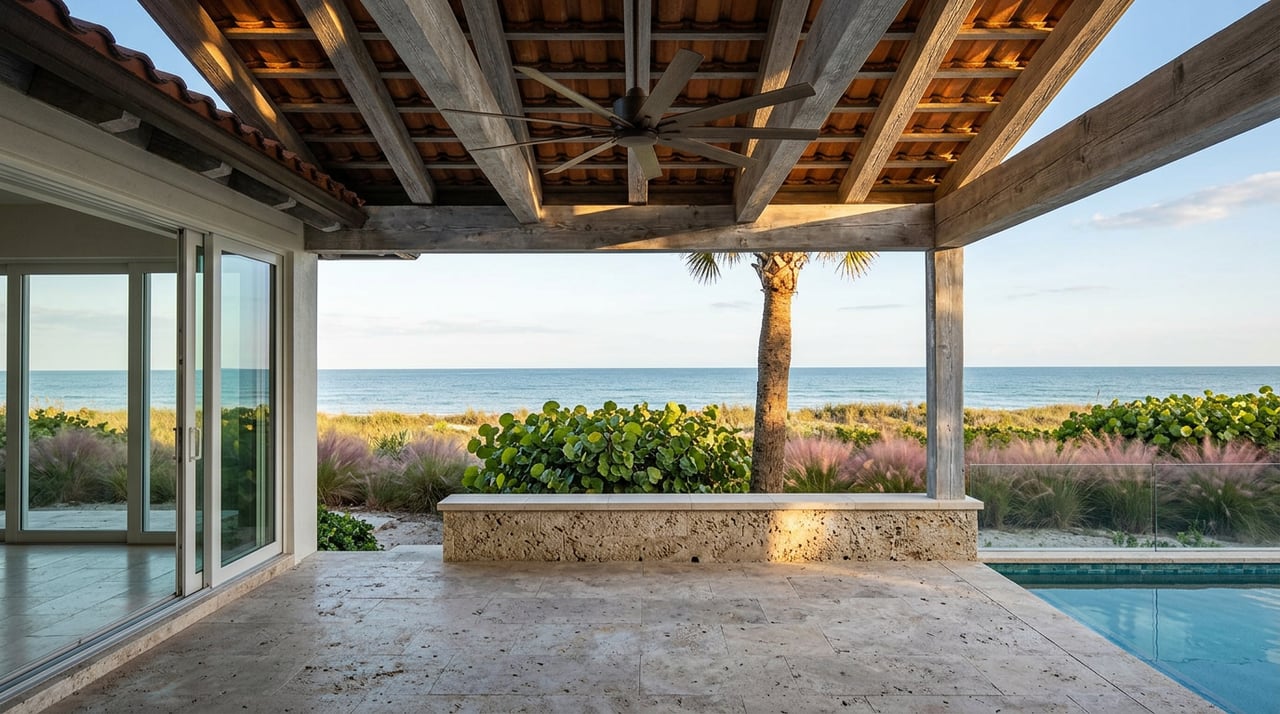
Same Coastline, Different Rulebook: What Actually Separates Vilano Beach From Anastasia Island
September 10, 2026
September 10, 2026
Stand at the north end of the Usina Bridge and look south. The water doesn't change. The sand doesn't change. The view of the St. Augustine Lighthouse across the inlet is the same whether you're standing in Vilano Beach or on Anastasia Island a few minutes' drive away. Yet a buyer comparing oceanfront homes on both sides of that bridge in 2026 keeps running into the same puzzle: nearly identical properties, same square footage, same finish level, same distance to the sand, and one consistently prices $50,000 to $100,000 lower than the other. That gap has been holding through mid-2026, according to a St. Augustine market update covering both submarkets, though the spread has started to narrow as more buyers catch on.
The instinct is to explain that gap with taste. Anastasia Island has the pier, the established restaurant row, the deeper bench of amenities. Vilano is quieter, more residential, still finding its commercial footing. Those things are true, and they matter to lifestyle. But they don't fully explain a five- or six-figure spread on comparable homes with comparable water access. The real explanation sits somewhere less romantic: a line on a map that most buyers never think to ask about until it shows up on a tax bill or a rental license application.
Most of Vilano Beach is unincorporated St. Johns County. It has no separate city hall, no independent zoning board, no city police department. The county handles its taxes, its building permits, and its short-term rental rules. Anastasia Island's oceanfront corridor, by contrast, largely falls inside the City of St. Augustine Beach, one of only three incorporated municipalities in St. Johns County. That city runs its own government layer on top of the county's.
This isn't a technicality. It changes who you call, what forms you file, and what the county assessor stacks onto your bill.
| Unincorporated Vilano Beach | City of St. Augustine Beach (Anastasia Island) | |
|---|---|---|
| Governing authority | St. Johns County | City of St. Augustine Beach, plus county |
| Property tax layer | County millage only | County millage plus city millage |
| Short-term rental rules | County's 2021 rental ordinance | Crest Cove's compliance guide describes a separate city ordinance and zoning caps |
| Building permits and inspections | St. Johns County Building Department | City of St. Augustine Beach permitting office |
None of this shows up on a listing sheet. It shows up in escrow, when a buyer's title company pulls the parcel and the closing agent starts asking which jurisdiction's rules apply.
St. Johns County runs one of the lowest effective property tax rates in Northeast Florida, roughly 0.93% for homesteaded properties on the county's own millage. Properties inside an incorporated city add that city's millage on top of the county rate. A home in unincorporated Vilano Beach pays the county rate and nothing more. A comparable home a few minutes south, inside St. Augustine Beach city limits, pays the county rate plus the city's own levy.
That difference is small on any single year's bill, but it compounds the way any recurring cost does, and it's exactly the kind of detail that never appears in a portal search filter. If you're comparing two homes by list price alone, you're comparing incomplete numbers. The county's own tax estimator lets you plug in a specific parcel and see the real number before you write an offer, which matters more than it sounds like it should, because the seller's current tax bill almost never reflects what a new owner will actually pay. Florida's Save Our Homes cap resets at sale, so whatever the seller has been paying based on years of capped assessment growth gets wiped clean the day you close. You start fresh at the new taxable value, in whichever jurisdiction that parcel sits.
For buyers who want to see the underlying rate structure directly, St. Johns County publishes its full millage sheet each tax year, broken out by taxing district. It's not exciting reading, but it's the actual document, not someone's summary of it.
This is where the jurisdictional split stops being an abstraction and starts affecting a business plan.
Unincorporated Vilano Beach operates under St. Johns County's short-term rental ordinance, adopted in 2021. It requires registration and compliance with health, safety, parking, and solid-waste rules, and it applies a guest cap for whole-home rentals under absentee ownership. It's one rulebook, administered by one county office, whether your parcel sits a block from the beach or back toward the Intracoastal.
St. Augustine Beach runs its own separate rental ordinance, distinct from both the county's rules and from the City of St. Augustine's downtown rules. Properties on Anastasia Island can fall under zoning-based caps that limit rentals to certain districts, some capped by month and others by week, depending on the parcel's specific zoning designation. Two houses on the same street can carry different rental allowances depending on how that parcel was zoned. A buyer who assumes "Anastasia Island" means one uniform rule set can end up structuring a purchase around a rental plan the parcel doesn't actually support.
The North Beach Community Alliance, a resident group active in Vilano and North Beach, has been tracking this from the other direction. Their own writing on the subject notes that Vilano and North Beach have always drawn vacationers, but the volume of new short-term rentals in the area has grown enough that residents have started asking the county for clearer enforcement. That's a useful signal for buyers too. A market attracting that much new rental supply is also a market where the county's registration and enforcement process is actively being tested, which means the paperwork matters more this year than it did five years ago, not less.
None of this makes one side of the bridge better than the other for an investor. It means the homework is different depending on which side you're buying into, and that homework has real dollar consequences if you're underwriting a rental income projection based on assumptions that turn out to be zoning-specific rather than universal.
Before leaning too hard on any single price statistic in a market this small, it's worth flagging how thin the data actually is. One widely cited tracker showed Vilano Beach's average house price jumping more than 100% year over year as of a recent month in 2026. That sounds like a market on fire. It's more likely a symptom of low transaction volume. Vilano Beach is a small enough submarket that a handful of high-end oceanfront closings in a single month can swing an average dramatically without reflecting anything about the broader trend. The same tracker's own data shows homes there aren't moving quickly, sitting closer to 89 days on market on average, which is not the signature of a market genuinely doubling in value.
A fuller picture, pulled from active listing data as of early September 2026, shows roughly 30 properties for sale in Vilano Beach with asking prices ranging from the high $400,000s to just under $4 million, averaging around $569 per square foot. That spread, not the single average, is the more honest description of the market. Vilano Beach isn't one price point. It's a range that runs from modest inland cottages to oceanfront estates, and the "average" only tells you something if you already know which slice of that range you're shopping in.
Put those pieces together and the original puzzle resolves into something more useful than "Vilano is cheaper." Vilano Beach is cheaper, in part, because it carries one less layer of municipal government, which shows up as a lower tax stack and a single, countywide rental ordinance instead of a patchwork of city zoning caps. That's a real, structural reason for the price gap, not a temporary market quirk, and it explains why the spread has been narrowing rather than closing outright. As more buyers who've been priced out of Anastasia Island discover that Vilano offers comparable ocean access with a simpler regulatory picture, demand follows, and the gap compresses. It hasn't closed, and there's no way to know if or when it will, but the direction is worth watching if you're deciding whether to act this year or wait.
For a buyer comparing a unit at Villages of Vilano or Seawatch of Vilano against something similar on Anastasia Island, the honest comparison isn't sale price against sale price. It's total cost of ownership against total cost of ownership, including the tax stack and the rental rules that come with each specific parcel. That comparison takes more legwork than a portal search, but it's the only version of the comparison that holds up after closing.
Does buying in unincorporated Vilano Beach mean fewer rules overall, not just different ones? Not necessarily. The county's ordinance still requires registration and compliance with safety, parking, and waste rules. It's one rulebook instead of overlapping city and county rules, which simplifies things, but it isn't a lighter-touch system across the board.
Will the price gap between Vilano Beach and Anastasia Island stay where it is? Recent market reporting from mid-2026 describes the gap as narrowing rather than fixed. There's no way to guarantee where it lands next, which is part of why buyers who want oceanfront access at a relative discount tend to move on Vilano listings sooner rather than later.
If you're weighing a home on either side of that bridge and want the tax estimate, the zoning check, and the rental rule read done before you write an offer, that's exactly the kind of groundwork Michele Tremblay walks clients through on every coastal comparison. Reach out to request a private consultation and get the full picture before you commit to either side of the inlet.
This article is general information, not legal, tax or financial advice. Consult a qualified professional about your situation.
Stay up to date on the latest real estate trends.
Etiam non quam lacus suspendisse faucibus interdum. Orci ac auctor augue mauris augue neque. Bibendum at varius vel pharetra. Viverra orci sagittis eu volutpat.
LET'S CONNECT
MICHELE TREMBLAY
13000 Sawgrass Village Cir. Bldg. 1, #3 Ponte Vedra Beach, FL 32082