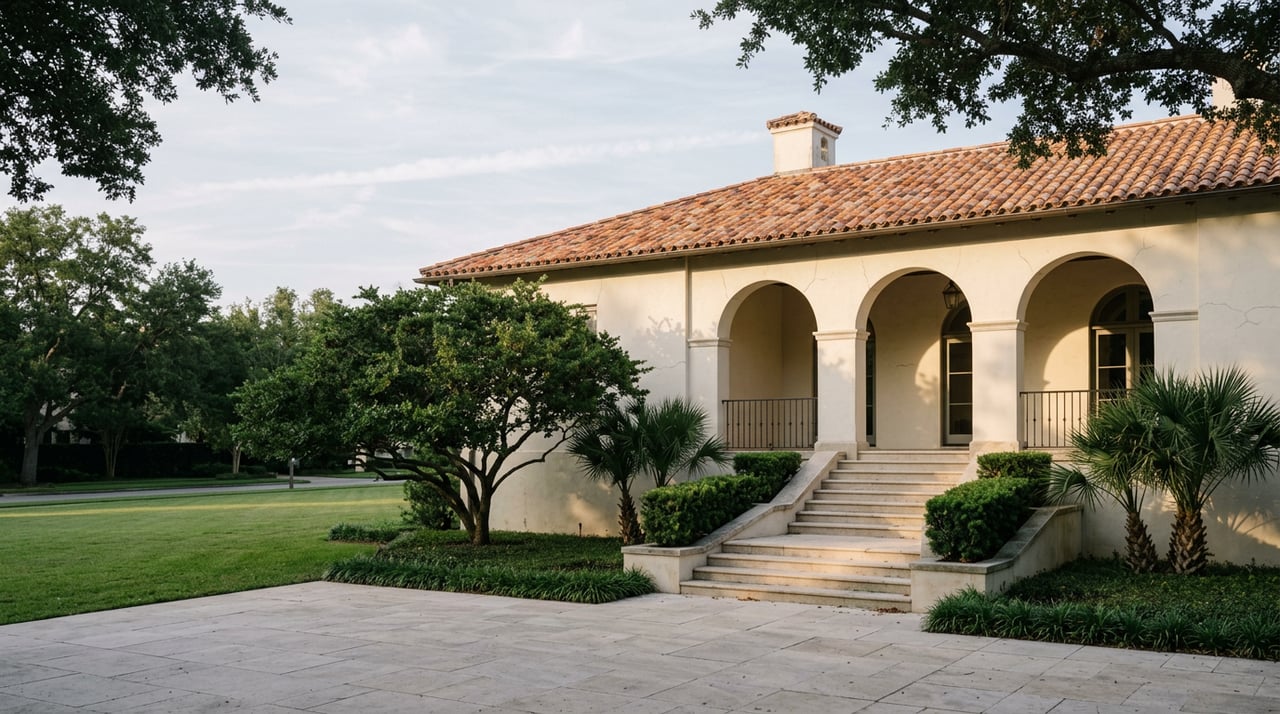
Why St. Augustine Flood Insurance Bills Can Differ
September 3, 2026
September 3, 2026
Picture two houses a few blocks apart in St. Augustine. Same elevation. Same FEMA flood zone. Same age of construction. On paper, their flood insurance should cost roughly the same. It won't necessarily, because premiums can reflect more than those three similarities.
One difference can be which government office is responsible for the ditch, the drain, and the floodplain map on that side of the line.
That distinction matters more than it used to. In August 2025, the city of St. Augustine announced that FEMA had upgraded its Community Rating System score to Class 4, a jump from Class 5 that translates into a 30 percent discount on most National Flood Insurance Program premiums for policies issued or renewed on or after April 1, 2026, up from the 25 percent discount the city carried before. That threshold has already passed. Anyone renewing an NFIP policy inside city limits this spring or summer should already be seeing the larger discount. A decade ago, the city sat at Class 7. That climb from 7 to 5 to 4 puts St. Augustine among roughly 25 communities nationwide rated Class 4 or better, according to the city's own announcement.
None of that changes a single property's elevation or its exposure to storm surge. What it changes is the bill, and only for the properties inside the right boundary.
The Community Rating System is a voluntary FEMA program that rewards local governments for going beyond the minimum floodplain standards. Cities earn points for things like maintaining drainage infrastructure, preserving open space, and updating building codes, and those points convert into a class rating from 1 (best) to 10 (no discount). St. Augustine's floodplain administrator, Richard "Buddy" Schauland, told the city commission that the jump reflected roughly 200 additional points earned largely through studies completed under the city's Watershed Master Plan.
As Action News Jax reported, he put it simply at the meeting: "We improved our score by almost 200 points, FEMA accepted our studies that had been done under the Watershed Master Plan."
According to Fludzone, the 30 percent applies to policies for properties inside a Special Flood Hazard Area within city limits. Properties outside the mapped high-risk zone but still inside the city get a smaller discount, generally around 10 percent. Both numbers are attached to the municipality, not to the flood zone map alone.
That's the part worth sitting with if you're comparing homes across St. Augustine and the surrounding area. St. Augustine Beach is a separate incorporated city with its own building department and floodplain program. Unincorporated St. Johns County, which covers inland communities like World Golf Village and Palencia, runs under the county's own CRS participation. A house that sits just outside the city of St. Augustine's limits is not automatically covered by the city's Class 4 rating, even if it shares a zip code, a school zone, or a real estate agent's mental map of "St. Augustine."
Local insurance sources report a wide range for flood premiums in this market. One St. Augustine insurance guide puts typical NFIP premiums for high-risk zones between $1,500 and $4,500 a year, with coastal Zone VE properties running higher because of wave-action exposure. A flood-specific broker serving the same market cites a broader range, roughly $480 to $4,800 a year, reflecting how much an individual property's construction, elevation, and flood zone can swing the number even before any city-level discount is applied.
That spread is the point. Flood insurance in this market was already priced property by property under FEMA's Risk Rating 2.0 system, which looks at elevation, distance to water, and construction type rather than a flat zone-based rate. Layer a 30 percent municipal discount on top of that and you get two forces moving the number at once: what your specific parcel looks like, and what government office is responsible for the floodplain it sits in.
For a homeowner paying near the top of that range, in the $3,000 to $4,500 territory that Zone VE and Zone AE properties in the historic core or on Anastasia Island can reach, a 30 percent reduction works out to roughly $900 to $1,350 a year. That's a number worth asking about directly rather than assuming from a listing photo of a renovated cottage on a pretty street.
The neighborhoods most affected by this discount are also the ones with the deepest flood history in St. Augustine. Davis Shores, on the north end of Anastasia Island, sits almost entirely in Zone AE. The land was originally swampy lowland until a 1,500-acre dredge-and-fill project in the 1920s created the neighborhood that exists today, and it still floods more readily than higher-ground parts of the county. Lincolnville, particularly the area around Lake Maria Sanchez, and the Abbott Tract carry similar histories as older, low-lying sections of the historic district.
These are also the neighborhoods where a 30 percent NFIP discount does the most real work, because they're the ones most likely to be paying premiums at the higher end of the range in the first place. Meanwhile, World Golf Village and Palencia, both largely outside the city of St. Augustine's limits and built on higher, better-drained land, already carry lower baseline flood costs. The city's CRS upgrade doesn't touch those communities directly, because they fall under the county's own floodplain program.
The result is a narrower gap between "flood-prone historic property" and "higher ground newer construction" than the flood zone map alone suggests, at least for anyone buying inside city limits. It's not a reason to treat flood risk as a solved problem. It's a reason to ask the specific jurisdictional question before comparing two neighborhoods on cost alone.
FEMA's CRS verification runs on a three-year cycle, and the letter notifying St. Augustine of its Class 4 status specified that the rating renews annually for the next three years only if the city keeps implementing the activities it certified. That's a normal feature of the program, not a red flag specific to this city, but it means the 30 percent discount is tied to continued municipal investment in drainage maintenance, floodplain management, and building code enforcement. If those activities lapse, the class rating can slip back down, the way it did move from 7 toward 4 through sustained work rather than a single event.
For a buyer thinking in five or ten year terms, that's worth knowing. The discount is real today and the city's trajectory has been upward for a decade, but it isn't a fixed line item the way property taxes are.
| CRS Class | Approximate SFHA Discount | Effective Period |
|---|---|---|
| Class 7 (roughly a decade ago) | Smaller discount tier | Historical |
| Class 5 (prior rating) | 25 percent | Through March 2026 |
| Class 4 (current rating) | 30 percent | In effect for policies issued or renewed since April 1, 2026 |
A few steps turn this from a curiosity into something you can use in a real transaction.
Confirm the flood zone directly through FEMA's Flood Map Service Center rather than relying on a listing sheet, since maps get revised and some St. Johns County parcels have shifted zones over time. Ask for the property's elevation certificate if one exists, since that single document can move a premium by hundreds or thousands of dollars a year depending on how far above base flood elevation the lowest floor sits. If a seller believes their home no longer belongs in a high-risk zone based on fill or grading, ask whether a Letter of Map Amendment has been filed, since a LOMA is FEMA's formal mechanism for removing a structure from a Special Flood Hazard Area.
And ask directly about flood history. Florida's HB 1049, effective October 1, 2024, requires sellers to disclose known flood damage and any federal flood assistance received on the property. That disclosure exists precisely because zone maps and city discounts describe probability, not the specific story of one house.
None of this is insurance or legal advice, and every number here should be confirmed against a current quote for the specific address, not treated as a rate you can count on sight unseen.
St. Augustine's flood insurance became meaningfully cheaper for a specific set of homeowners this spring, and the reason is a municipal floodplain program most buyers never think to ask about. If you're weighing a historic cottage in Davis Shores against a newer build in Palencia, the flood zone map is only half the comparison. The other half is which city or county is responsible for the water, and whether that government is still doing the work that earned this discount in the first place.
Does the 30 percent discount apply automatically to every St. Augustine property? It has applied automatically to most NFIP policies for properties inside the city of St. Augustine's limits since April 1, 2026. It does not extend to properties in St. Augustine Beach or unincorporated St. Johns County, which run separate floodplain programs.
What about homes in World Golf Village, Palencia, or St. Augustine Beach? Those areas fall outside the city of St. Augustine's jurisdiction and its CRS Class 4 rating. Buyers considering those communities should confirm which floodplain program and CRS class applies to that specific address.
Could this discount go away? FEMA reverifies CRS ratings on a three-year cycle, and the city's rating renews annually within that cycle only if it continues its certified mitigation activities. The trend has moved in the city's favor for a decade, but it isn't guaranteed permanently.
If you're comparing St. Augustine neighborhoods and want to understand what a specific address actually costs to own, not just what the flood zone map suggests, Michele Tremblay can walk you through the details property by property. Request a Private Consultation to start the conversation.
Stay up to date on the latest real estate trends.
Etiam non quam lacus suspendisse faucibus interdum. Orci ac auctor augue mauris augue neque. Bibendum at varius vel pharetra. Viverra orci sagittis eu volutpat.
LET'S CONNECT

MICHELE TREMBLAY
13000 Sawgrass Village Cir. Bldg. 1, #3 Ponte Vedra Beach, FL 32082